Newsletter
Join the Community
Subscribe to our newsletter for the latest news and updates
Quick verdict: TheAudioStuff is unusually useful because it combines two things that rarely live together: a focused catalog of human-signed audio reviews and 16 interactive browser tools that produce inspectable results. Its strongest features are the ABX blind test, headphone power calculator, room-acoustics tools, and hi-res file analyzer. The main caveat is equally important: a spectrum can reveal clues about a file's history, but it cannot prove provenance in every case, and subjective listening notes remain subjective even when the methodology is transparent.
AIToolFame rating: 8.8/10
This rating is AIToolFame's editorial judgment, not a score published by TheAudioStuff.
Disclosure: AIToolFame independently reviewed the public website and its built-in tool demonstrations. Statements about TheAudioStuff's internal editorial process are attributed to its published methodology unless they can be verified directly on the page. Facts and catalog counts were checked on September 2, 2026.
Generative AI has made competent-looking product copy almost free. A model can summarize a specification sheet, imitate audiophile vocabulary, add a pros-and-cons list, and publish an apparently complete review without anyone touching the product.
Audio is particularly exposed to this problem. Words such as warm, airy, fast, and resolving sound authoritative but are easy to generate and difficult to audit. Specifications are useful, yet they do not tell you how a headband feels after two hours, whether a cable transfers handling noise, how an ear-pad seal changes bass response, or whether a louder comparison is being mistaken for a better one.
TheAudioStuff takes a more defensible route. It publishes named bylines, a public scoring framework, a reference chain, loaner disclosures, and a stated minimum listening period. It also gives readers tools that calculate or analyze something rather than merely describe it.
That combination is the site's real moat. The prose asks for trust, but the calculators and tests return outputs a reader can inspect.
At the time of this review, TheAudioStuff publicly lists:
The About page attributes 64 reviews to Jakub Charkiewicz and four to Bastien Beauchamp. It also says adjacent verdict bands overlap intentionally and that a review whose score falls outside the permitted band fails the site's build checks.
These are current, first-party figures rather than timeless facts. The review count and comparison count will naturally change as the site publishes new work.
The tools directory covers listening tests, equipment matching, acoustics, signal generation, and file analysis. TheAudioStuff states that the tools run in the browser using the Web Audio API and JavaScript, require no account, and do not upload the user's audio files.
That is a meaningful product decision. A generic AI answer can explain Ohm's law, but a calculator can apply the formula consistently to the exact sensitivity, impedance, target level, and crest factor entered by the user. An AI summary can discuss expectation bias, but an ABX tool can randomize trials and calculate a binomial p-value from actual answers.
The difference is not “AI versus math” in the abstract. It is uncheckable prose versus a repeatable interaction with visible inputs and outputs.
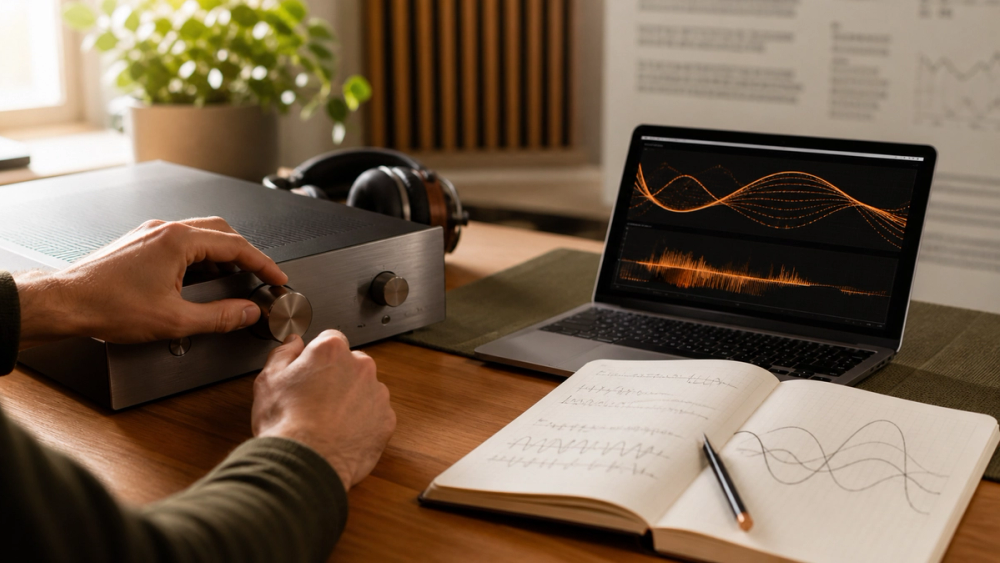
The most distinctive utility is the Hi-Res Audio Fraud Detector. It accepts MP3, FLAC, WAV, AAC, OGG, AIFF, and ALAC files, analyzes them locally, and displays a whole-file peak-hold frequency spectrum generated with 32k FFT analysis in one-second windows.
The basic idea is sound. A 44.1 kHz source cannot contain information above its 22.05 kHz Nyquist limit. If that source is resampled into a 96 kHz container, the new header allows higher frequencies, but the conversion cannot reconstruct musical information that was absent from the original. A sharp cutoff near the earlier limit can therefore be evidence of upsampling. Lossy encoders may leave a lower cutoff, often somewhere in the upper audible band.
We ran both built-in demonstrations. The synthetic “fake 96 kHz” example was classified as Likely upsampled, with content stopping at 20.6 kHz. The synthetic “true 96 kHz” example was classified as Genuine hi-res, with generated energy extending to 48.0 kHz. Those demos confirm that the interface and verdict flow work as described for controlled inputs.
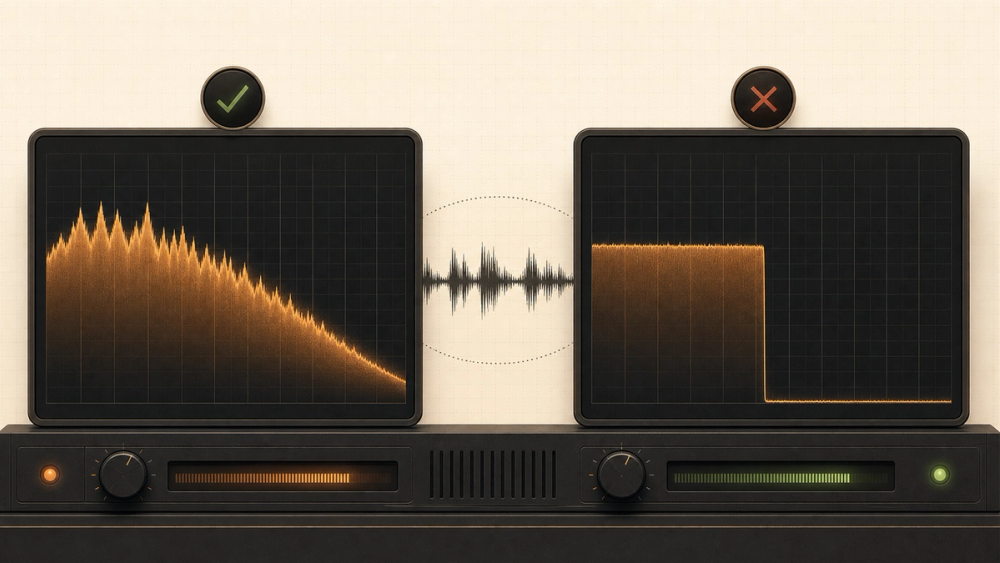
A cutoff is a clue, not universal proof of fraud. Legitimate recordings may contain little ultrasonic energy because of microphones, analog filters, production choices, restoration work, or the source material itself. Conversely, ultrasonic noise can extend beyond 22 kHz without proving that the music has meaningful high-resolution content.
The safest interpretation is:
Used with those limits in mind, the tool is a fast and valuable screening instrument. It is more informative than trusting a “24-bit/192 kHz” label, but it is not a forensic chain-of-custody report.
The ABX Blind Test gives the listener two known references, A and B, and an unknown X that is randomly assigned to one of them. The listener identifies X over a predetermined number of rounds.
The implementation includes several details that matter:
TheAudioStuff recommends deciding the trial count in advance. That is good statistical hygiene: stopping only when the score looks impressive inflates the chance of a misleading result.
The site also states the most important limitation correctly. A null result does not prove that two signals are identical. It means that this listener did not demonstrate a difference between these samples under these test conditions. That distinction is often lost in online arguments about codecs, filters, cables, and high-resolution formats.
The Headphone Power Calculator accepts sensitivity in dB SPL/mW or dB SPL/V, impedance, listening target, and program crest factor. It returns required power and voltage, then shows how much headroom a source has.
This is more useful than the common rule that “high impedance means hard to drive.” Impedance is only part of the picture. Sensitivity and the desired peak level determine the actual requirement. The page also exposes its formulas, making the result easier to audit.
The wider suite includes a speaker wattage calculator, an SPL and distance calculator, a room-mode visualizer, an acoustic-panel calculator, a safe-listening calculator, a signal generator, a graphic equalizer, bit-depth and cable calculators, and ear-training tools. Not every buyer needs all 16, but the collection turns the website into a compact audio workbench rather than a review archive with a few decorative widgets.
Google describes E-E-A-T as experience, expertise, authoritativeness, and trust, with trust at the center. It is not a single public score that a website can claim for itself. The useful question is whether a reader can see evidence that supports those qualities.
TheAudioStuff provides several strong on-page signals:
The site says every review receives at least two weeks of daily use, multiple genres, multiple sources, and comparisons against reference products. It says loaner units are disclosed and brands receive no pre-publication editorial control.
Those claims are well presented, but an outside reader cannot independently observe every listening hour or internal conversation with a manufacturer. The responsible conclusion is that TheAudioStuff offers unusually strong visible accountability, not that every process claim has been independently audited.
That nuance strengthens the E-E-A-T case. Trustworthy reviewing is not about pretending subjectivity has disappeared. It is about identifying the reviewer, declaring the method, disclosing incentives, naming reference points, and separating observation from inference.
These alternatives serve different needs, so a fair comparison should avoid declaring one universal winner.
TheAudioStuff is strongest as an integrated independent workbench. It combines selective, reference-anchored reviews with 16 calculators, analyzers, tests, and trainers. Its review methodology puts long-form listening first and adds measurements when the writers believe they clarify an audible claim or challenge marketing.
SoundGuys publishes its testing methodology and describes standardized headphone measurements using a Brüel & Kjær 5128 head simulator, SoundCheck software, and controlled tests for frequency response, isolation, noise canceling, microphones, and battery life, alongside subjective use. For shoppers who prioritize a large library of standardized headphone measurements, that is a major advantage.
TheAudioStuff's advantage is different: its browser utilities are integrated directly into the same site as its reviews and comparison pages. The two sites can be complementary rather than interchangeable.
Audio Science Review is built around instrumented testing and a large discussion forum. It is often the stronger destination when a buyer wants bench measurements, technical debate, and community scrutiny. Its forum format can also require more effort to synthesize than a single structured review.
TheAudioStuff is easier to approach as a guided buying workflow, while Audio Science Review is better suited to readers who want to inspect measurement-heavy threads and discuss methodology in depth.
AI can be useful for discovery, summarization, terminology, and shortlist creation. A text-only model cannot, by itself, establish that a writer wore a headphone, felt a pressure hotspot, heard cable handling noise, or ran a controlled comparison. An AI-enabled system can analyze supplied measurements or call specialist tools, but a page that offers only polished adjectives, copied specifications, and affiliate links provides few anchors for trust.
TheAudioStuff's named authors, disclosed method, product-specific observations, and interactive tools create more evidence than generic generated copy. That does not make every subjective conclusion universal, but it makes the reasoning easier to inspect.
The most practical approach is not to reject AI. It is to assign each source the work it can actually do.
This workflow uses AI as an efficient assistant without asking it to invent physical experience.
The site has real constraints, and readers should know them before treating it as a complete authority.
None of these limitations negates the site's value. They define where it fits in a serious research process.
TheAudioStuff succeeds because it gives readers more than confident language. Its 16 browser tools expose formulas, spectra, randomized trials, and practical outputs. Its reviews identify authors, reference products, scoring rules, disclosures, and a stated listening protocol. Together, those elements create a stronger trust surface than an anonymous page assembled from specifications and generic audiophile adjectives.
The Hi-Res Audio Fraud Detector is the headline tool, provided readers respect its forensic limits. The ABX engine is arguably more important because it turns “I can definitely hear it” into a testable claim. The equipment calculators then make the site useful before and after a purchase.
At 8.8/10, TheAudioStuff earns a recommendation as a focused audio review site and a genuinely useful browser DSP toolkit. Pair it with manufacturer specifications and standardized measurement sources, and it becomes an excellent part of a modern, evidence-aware buying process.
Visit TheAudioStuff or browse its 16 free audio tools.
The site states that all 16 browser tools are free, require no account, and run without uploading the user's audio files. The reviews, comparisons, guides, and glossary are also publicly accessible.
The site says every score and verdict is written and signed off by a named human reviewer, with no ghost-written placements. The public bylines are Jakub Charkiewicz and Bastien Beauchamp. AIToolFame can verify the bylines and author pages, but not every step of the internal writing process.
It can reveal spectral evidence consistent with upsampling or a lossy source, especially a sharp cutoff near an earlier sample-rate limit. That evidence is useful but not conclusive in every recording. Production filters, microphones, source material, and ultrasonic noise can complicate interpretation.
It estimates the probability of achieving at least the observed hit count by random guessing if X is equally likely to be A or B. A low p-value supports evidence of discrimination under the test conditions. It does not measure how large the audible difference is, and an unsuccessful test does not prove the files are identical.
It depends on the job. TheAudioStuff stands out for integrated browser tools and selective reference-anchored reviews. SoundGuys offers standardized lab and use testing, while Audio Science Review emphasizes measurement-heavy reviews and technical forum discussion. Using more than one source gives the strongest result.