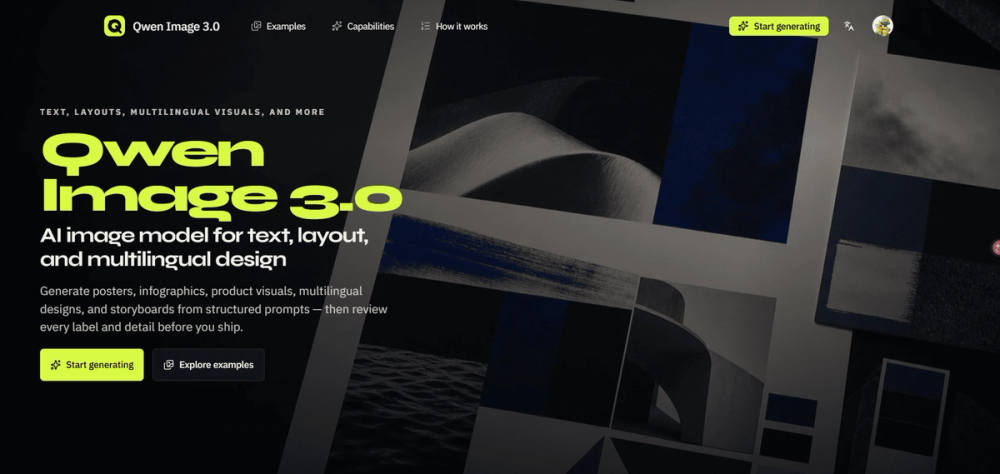
Qwen Image 3.0 is an advanced AI image model designed for generating content-heavy visuals with precision and control. Unlike traditional image generators that focus primarily on style, Qwen Image 3.0 excels at producing images with readable text, structured layouts, and multilingual designs, making it ideal for professional applications where accuracy and clarity are paramount.
Key Capabilities:
- Structured Content Generation: Users can describe complex layouts, panels, labels, formulas, diagrams, and nested structures within a single detailed brief. This eliminates the need to stitch together multiple vague prompts, allowing for the creation of rich, information-dense visuals like infographics and detailed posters.
- Accurate Text Rendering: A core focus of Qwen Image 3.0 is its ability to render exact headlines, labels, formulas, and annotations directly within the image. This ensures that text is an integral part of the composition, not an afterthought. Users are encouraged to review spelling, numbers, and claims, treating every result as a draft.
- Multilingual Design Planning: The model supports native rendering across 12 languages, enabling users to plan a single design system that adapts across different locales. This is particularly useful for localization teams who need to maintain visual consistency while changing copy across languages, allowing for review of translations and line breaks.
- Composition and Style Control: Qwen Image 3.0 allows for precise control over composition elements such as focal point, reading order, spacing, camera angle, color palette, and material cues. This ensures that the generated image is not only visually polished but also functionally useful and aligned with specific design requirements.
How it Works:
The process is streamlined into three main steps:
- Describe the Deliverable: Users write a comprehensive prompt, akin to a design brief, detailing the purpose, main subject, desired layout (square 1:1, landscape 16:9, or portrait 9:16), exact text, visual style, and any specific constraints.
- Generate a Draft: The structured brief is submitted to the Qwen Image 3.0 model through a live generation desk, which then produces the initial visual draft.
- Review and Refine: Users inspect the generated image for accuracy in text, numbers, facts, translations, layout, and fine details. The prompt can be updated iteratively to refine the output until it meets the desired specifications.
Use Cases and Target Users:
Qwen Image 3.0 is particularly relevant for professionals who require visuals where text, layout, sequence, language, or fine detail are critical components:
- Growth Marketers: For creating posters and product ads with exact headlines, offers, and brand directions.
- Product Designers: For generating UI or game-interface concepts by describing screens, controls, states, and visual hierarchy.
- Educators: For arranging concepts, formulas, and diagrams into infographics or teaching slides with deliberate reading orders.
- Localization Teams: For exploring compositions across multiple languages, ensuring accurate translations and consistent visual systems.
- Creative Directors: For reviewing connected scenes, subject continuity, camera direction, and pacing in storyboards or multi-panel sequences.
- Ecommerce Teams: For combining product details, materials, lighting, benefit labels, and offer spaces into photorealistic product visuals.
This AI image model empowers users to move from a clear brief to a reviewable draft, significantly accelerating the visual production workflow for content-heavy designs.