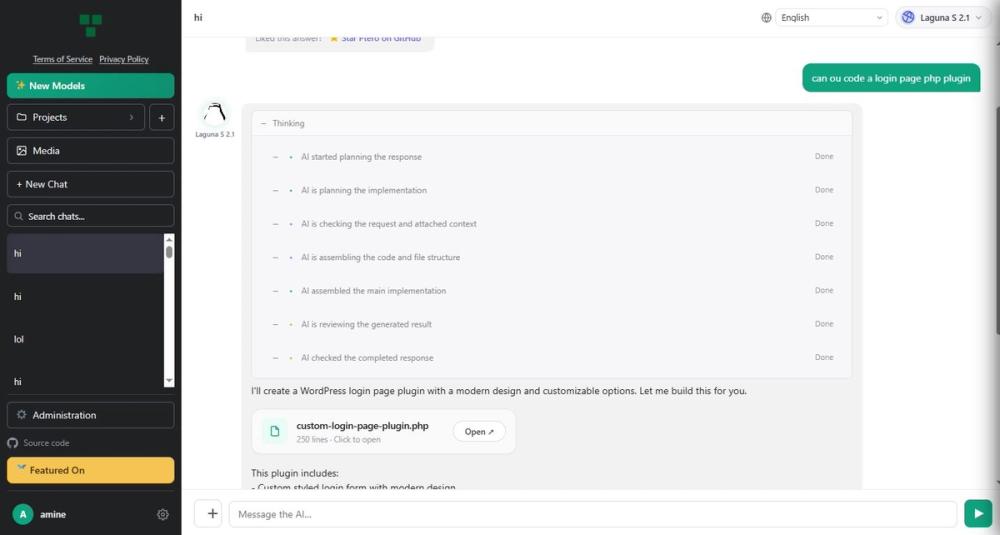
Ptero is an innovative, completely free, and open-source AI chat platform specifically designed to empower developers. It stands out by offering unrestricted access to a diverse array of advanced large language models (LLMs) without any premium plans, subscriptions, or paywalls, ensuring that powerful AI tools are accessible to everyone. This commitment to freeness is a core tenet, making it an ideal resource for individual developers, students, and small teams looking to leverage AI without financial barriers.
The platform integrates a rich set of features tailored for coding and development workflows. Users can interact with various cutting-edge AI models, including Mercury 2, Laguna S 2.1, MiMo V2.5, Llama 3.3 70B, DeepSeek V4 Pro/Flash, and several models from the Qwen, MiniMax, Mistral, Nemotron, and Ministral series. Some highly advanced models like Claude Opus 4.8 and Claude Haiku 4.5 are unlockable simply by starring Ptero's repository on GitHub, fostering community engagement and open-source support.
Ptero enhances developer productivity with specialized tools such as an integrated Monaco Code Editor, allowing users to write, edit, and test code directly within the chat interface. A Live HTML Preview sidebar provides instant visual feedback for web development tasks. Furthermore, the ability to attach GitHub repositories directly to conversations enables the AI assistant to analyze and provide context-aware assistance on existing codebases, streamlining debugging, code reviews, and feature development. Users can also attach images and various file types (PDF, DOCX, TXT, video, audio) to their chats, expanding the scope of AI assistance beyond pure text.
Privacy is a paramount concern for Ptero. Unlike many other AI services, Ptero does not store user conversations or messages on its servers. All chat history and guest identity tokens are stored exclusively in the user's browser's local storage, giving users complete control over their data. Messages are transmitted to selected third-party AI providers only in transit and are not retained by Ptero. The platform also provides anonymous usage counters and per-model feedback tallies to maintain service reliability without compromising user privacy.
The user interface is intuitive and supports multiple languages, including English, Arabic, Chinese, Spanish, French, German, Portuguese, Russian, Hindi, Japanese, Korean, Turkish, Italian, and Indonesian, making it globally accessible. Conversation management features like "Projects" allow users to organize related chats, and a search function helps quickly locate past discussions. Ptero's open-source nature, with its code publicly available on GitHub, promotes transparency and allows the community to contribute to its ongoing development. This combination of powerful, free AI, developer-centric features, and a strong commitment to privacy makes Ptero a valuable tool for the modern developer.